In Wichita, a sump pump is not an accessory — along the Arkansas and Little Arkansas corridors it is the only thing standing between a rising water table and your basement floor, and everywhere else it is the discharge end of every waterproofing system we build. Yet most pumps we meet are undersized, unsealed, plugged into a basin that collects nothing, or one power outage away from irrelevance during exactly the storm that needs them most.
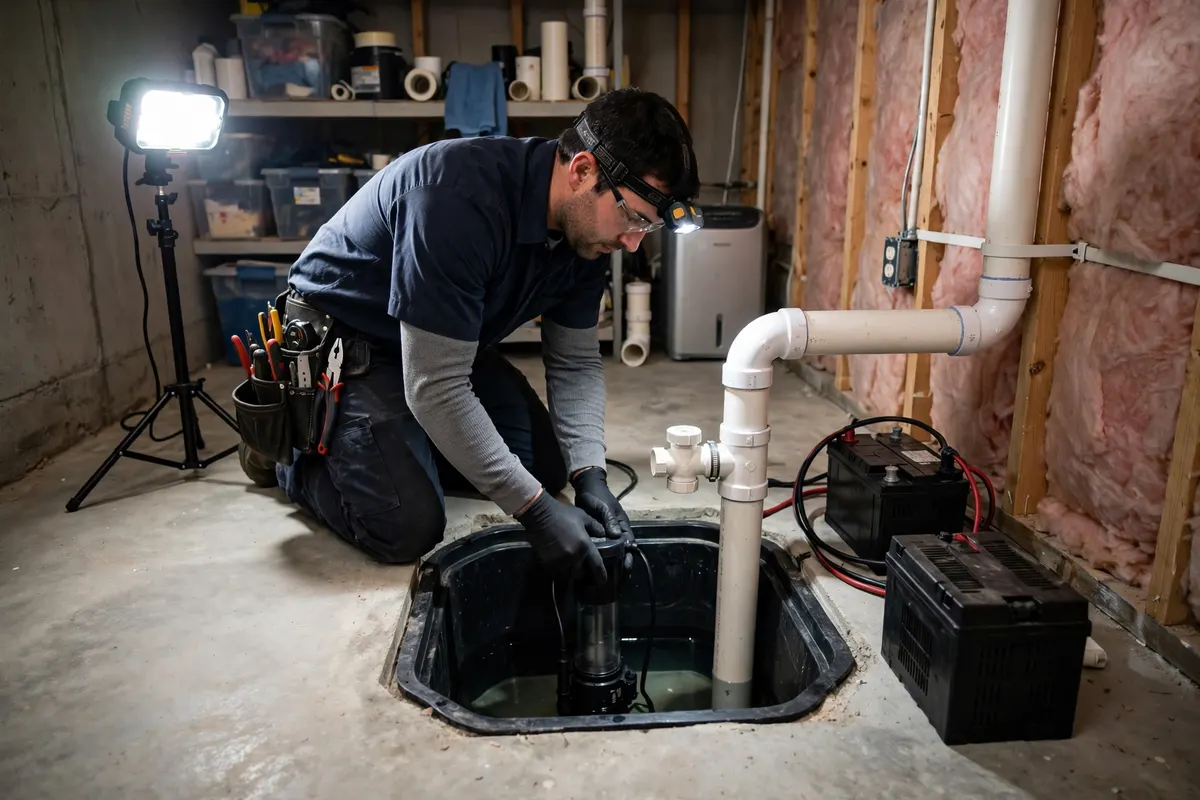
Plumber installing a new submersible sump pump and battery backup in a Wichita KS basement basin.
Wichita Foundation Repair installs sump systems as systems: a sealed basin placed where the water actually collects, a pump sized to the home's inflow (not the cheapest on the shelf), a check valve and discharge routed far enough from the house that the water is not recycled, and a battery backup for the outage that comes with every serious Kansas storm. We also build the drainage half — interior channels and exterior yard drainage that feed the pump instead of the basement.
Signs Your Sump or Drainage Setup Needs Work
The pump runs constantly — or never
Constant running in wet weather can mean an undersized pump, a stuck float, or groundwater inflow that drainage should be sharing. A pump that never runs while corners stay wet means water has no path to the basin. Both are design problems with design fixes.
No battery backup on a finished basement
The arithmetic is brutal: the storm that floods Wichita basements is the storm that cuts power. If your basement is finished or stores anything of value, a pump without backup is protection that resigns at the moment of need.
Water returns — discharge too close to the house
A discharge that dumps at the foundation line pours the basement's water back into the soil beside the wall, where it re-enters and gets pumped again — a treadmill that wears the pump and never dries the soil. Discharge belongs well away from the house, on a slope that carries it off.
A basin that is open, smelly or full of silt
Open basins admit radon and soil gas, smell in summer, and let debris reach the pump. Silt filling the basin means soil is migrating with the water — a drainage and footing concern, not just a cleaning chore. Sealed, gasketed lids and proper gravel bedding are the corrections.
Yard water standing against the foundation
Ponding along walls after rain, downspouts ending at the footing, and grading that funnels the yard toward the house all load the foundation with water the pump must then fight. Exterior drainage — grading, downspout extensions, French drains — removes the load at the source.
The pump is older than its warranty by years
Sump pumps are wear items with a working life commonly of 7–10 years, and they fail silently — the failure is discovered at the first big rain. If you do not know your pump's age or last test date, that is the finding; replacement on your schedule beats replacement on the storm's.
How We Install a Sump System — Our 5-Step Process
1
Trace the water and size the system
We establish where your water actually enters and how fast — basin inflow, water table behavior, drainage coverage — then size the pump and basin to the measured inflow with head pressure calculated for your discharge run, not guessed from horsepower marketing.
2
Set or rebuild the basin
A sealed, gasketed basin is set at the true low point, bedded in washed gravel, and connected to the interior drain channel where one exists or is being added. Radon-ready sealing comes standard — the lid is airtight, the penetrations gasketed.
3
Install pump, check valve and discharge
The primary pump is installed with a quiet check valve, union fittings for service, and discharge piping routed through the rim and out — extended at grade away from the foundation with a freeze-conscious outlet that will not ice shut in a Kansas January.
4
Add battery backup and alarm
A battery-powered backup pump is installed on the same basin with its own float, charger and a high-water alarm — the system that calls for attention before water reaches the floor, and keeps pumping through the outage that disables the primary.
5
Flood-test and hand over the rhythm
We flood-test both pumps, verify the check valve and alarm, and walk you through the twice-a-year test (a bucket of water and two minutes). You receive the equipment paperwork and install photos — and a system whose working you have seen, not just heard described.
What Do a Sump Pump & Drainage Cost in Wichita, KS?
Published cost guides put a straightforward pump replacement or new installation commonly between about $800 and $2,500 depending on whether a basin must be cut in, the pump's capacity, and discharge length; adding a battery backup system typically adds several hundred to around a thousand. Interior drainage that feeds the pump is priced by the linear foot, and exterior yard drainage by the run and outfall involved.
Our quote separates the pieces — basin, primary pump, backup, discharge, drainage — so you can see what each part of dry costs. The comparison that matters is not pump versus pump; it is system versus the first flooded-basement bill, which in a finished space exceeds the whole installation several times over. We install the system we would defend in that comparison, and we put its price in writing first.
Why Wichita Homeowners Choose Wichita Foundation Repair
Sump work fails quietly and cheaply in the same place: sizing by shelf price instead of inflow. A pump that cannot outrun a wet-season water table will run itself to death proving it, and a basin placed where the slab was easy to cut — not where the water collects — protects the wrong corner beautifully. We start from the water's behavior and build backward to the equipment, which is the only order that works.
We also treat the pump as one part of the foundation's water story. If your gutters are loading the wall, your grading is feeding the footing, or your discharge is recycling the same water, we say so and quote those fixes alongside — because selling a bigger pump to fight a fixable yard is a sale, not a solution.
Commonly 7–10 years of service, less under constant cycling, more in a dry basin. Because failure is silent until a storm, we recommend testing twice a year and replacing on age and condition rather than waiting for the failure — which always introduces itself during the rain you needed it for.
What size sump pump does my Wichita home need?
It depends on inflow rate and lift height, not on the house's size alone. River-corridor homes with high water tables often need a strong 1/2 HP primary where a 1/3 HP suffices elsewhere. We measure or estimate your inflow during the visit and size the pump — and its backup — to the water you actually get.
Is a battery backup really necessary?
For unfinished storage basements, it is a judgment call. For finished basements, yes — outages and peak water arrive together in Kansas storms, and the backup is the only pump that works then. The backup also covers primary-pump failure, the other silent scenario. It is the cheapest line in the system relative to what it protects.
Can you fix my yard drainage too?
Yes — exterior drainage is the other half of this service: regrading at the foundation line, downspout extensions and buried lines, and French drains where surface water needs intercepting. Often the yard work shrinks the load enough that the basement system becomes simple. We quote both halves together so the whole water path is solved once.
What maintenance does a sump system need?
Twice a year: pour water in to trip both floats, confirm the check valve holds, glance at the battery charger's indicator, and make sure the discharge outlet is clear. Two minutes, no tools. We show you at installation, note it in your paperwork, and can fold the check into any later service visit.
Need Sump Pump Installation & Drainage in Wichita?
On Wichita clay, foundation movement does not stop on its own — it pauses in wet months and advances in dry ones. A free inspection with floor-elevation readings tells you exactly where your home stands and what, if anything, it needs. No pressure, no obligation.