Water in your basement right now?Same-day response across the Wichita metro — call (316) 555-0147
Basement Waterproofing in Wichita, KS
Wichita basement water arrives two ways. Along the Arkansas and Little Arkansas river corridors, a high water table pushes groundwater against foundation walls for weeks after the rivers rise. Everywhere else, Kansas thunderstorms dump inches of rain on clay soil that cannot absorb it — the water stacks against your walls (hydrostatic pressure) until it finds the floor joint, a crack, or a tie hole. Waterproofing that works here has to relieve that pressure, not just paint over it.
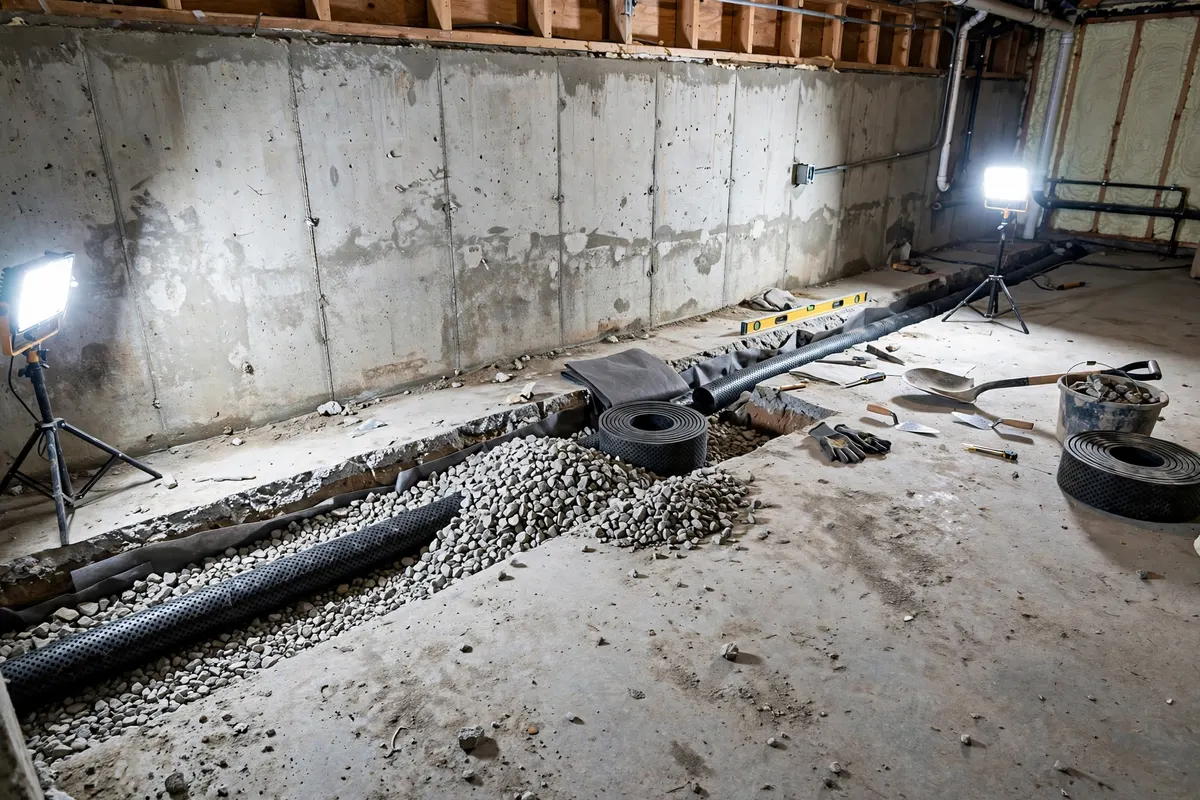
Interior basement waterproofing drainage channel being installed along the footing of a Wichita KS basement wall.
Wichita Foundation Repair waterproofs from the inside with a perimeter drainage system: a channel at the footing collects the water the wall and floor joint release, routes it to a sealed sump basin, and a properly sized pump sends it out and away from the house. It is the approach that works regardless of landscaping, decks and driveways outside — and it comes with the crack and drainage repairs that keep the system from being overwhelmed.
Signs Your Basement Needs Waterproofing — Not Another Dehumidifier
Water at the wall-floor joint after rain
The cove joint — where the floor meets the wall — is the most common entry point in Wichita basements, because pressure builds exactly there. Water that appears along the base of a wall after storms is groundwater winning, and only a pressure-relief drain fixes it.
Efflorescence — white crust on the walls
That white, chalky mineral residue is left behind by water traveling through the concrete and evaporating. It is the wall's diary of water movement: even when the basement looks dry, efflorescence says water is passing through the wall regularly.
Musty smell that never leaves
A basement that smells musty in every season has a moisture source, not a ventilation problem. Mold needs only moisture and time; until the water is controlled, cleaning treats the symptom and the smell — and the spores — come back.
Peeling paint and bubbling wall coatings
Paint and 'waterproof' coatings blister from behind when moisture vapor pushes through the wall. Coatings fail on Wichita clay-side walls because the pressure is real; a coating is a finish, not a waterproofing system.
A sump pit that is always dry — or always running
A pit that never sees water while the corners are wet means the water has no path to the pump. A pump that runs constantly in wet seasons may be undersized or fighting a rising water table barehanded. Both are drainage-design problems, and both are fixable.
Rust on appliances and stored-item damage
Water heaters and furnaces rusting at the base, cardboard boxes wicking moisture, and stored furniture smelling of mildew are the slow costs of a wet basement — they add up quietly until the finished-basement estimate arrives.
How We Waterproof a Basement — Our 5-Step Process
1
Find the water's actual path
We inspect during or after rain when possible, trace stains and efflorescence, check the cove joint, cracks, window wells, and exterior grading and gutters. The plan follows the water's route — and sometimes the honest first fix is outside, with downspouts and grading.
2
Open the perimeter and install the drain
A narrow trench is opened along the inside footing, and a perforated drain channel is bedded in washed gravel at footing depth — below the floor, where pressure builds. Wall water is directed into the channel behind a drainage board.
3
Seal cracks and set the sump basin
Leaking cracks are injected, tie holes sealed, and a sealed sump basin is installed at the low point with a properly sized pump, check valve and discharge routed well away from the foundation — not dumped at the flowerbed to recycle.
4
Restore the floor and test the system
The trench is re-concreted flush, the system is flood-tested, and the pump's cycle is verified. Where the basement is or will be finished, a battery backup is offered — Kansas storms that flood basements also cut power.
5
Document, warrant and hand over
You receive photos of the buried system, the pump and warranty paperwork, and a simple maintenance rhythm (test the pump twice a year; we show you how). A dry basement you can verify beats a dry basement you have to take on faith.
What Does Basement Waterproofing Cost in Wichita, KS?
Published cost guides put interior basement waterproofing at an average around $5,247 nationally, with partial-perimeter systems (one or two walls) below that and full perimeters with a new sump system above it. Wichita pricing follows the same shape: the variables are linear feet of drain, whether a basin and pump are new, and how much concrete and finish work rides along.
Set that against the cost of the alternative: one flooded finished basement — drywall, flooring, furniture, mold remediation — routinely exceeds the price of the system that would have prevented it, and unlike the system, it is not warranted. Our quote is itemized by wall and component, in writing, after we have traced your water's actual path. Sometimes that path ends at a $0 exterior fix, and when it does, that is the quote you get.
Why Wichita Homeowners Choose Wichita Foundation Repair
Waterproofing is sold on fear more than any service we offer, so we sell it on plumbing instead: water follows pressure and paths, and our job is to give it a better path than your basement floor. Every system we install can be explained in one drawing — where the water enters, where it is collected, where it is discharged — and if a contractor cannot draw yours, do not buy it.
We also fix causes before symptoms. Half the 'waterproofing' calls in Wichita trace to gutters dumping roof water against the wall, or grading that slopes a yard of clay toward the house. Those fixes are cheap and we will put them in writing even when they shrink our own job — because a dry basement that stays dry is the only advertisement this work has ever needed.
Interior or exterior waterproofing — which is right for my Wichita basement?
Interior drainage manages groundwater and hydrostatic pressure reliably and is the standard fix for cove-joint and floor leaks, at a fraction of exterior excavation cost and without tearing up landscaping. Exterior membranes make sense on new construction or when a wall also needs structural work from outside. We recommend per house, and explain why on yours.
Will waterproofing stop the musty smell?
Once the water source is controlled and the space dries, the smell source is gone — existing mold on surfaces still needs cleaning, and a dehumidifier helps a finished basement stay in range. But no cleaning or dehumidifier holds against active water entry; the drain system is what makes the smell stay gone.
How long does interior waterproofing take?
A typical full perimeter takes 2–3 days: a day of concrete work and drain installation, a day for the basin, pump and discharge, and a day of restoration and testing. Partial perimeters are often a single day. The basement remains yours in the evenings throughout.
Do I need a battery backup for the sump pump?
If the basement is finished or stores anything you value, yes. The storms that push the most water against a Wichita foundation are the same ones that knock out power, and a pump without power is a bucket. A backup is inexpensive insurance and we size it with the main pump as one system.
Is the waterproofing system warranted?
Yes — the drainage system is warranted against water on the floor from the walls and cove joint it serves, in writing, and the warranty transfers to a new owner. Pump warranties follow the manufacturer. At a home sale, that transferable paperwork answers the buyer's wet-basement question before it is asked.
Need Basement Waterproofing in Wichita?
On Wichita clay, foundation movement does not stop on its own — it pauses in wet months and advances in dry ones. A free inspection with floor-elevation readings tells you exactly where your home stands and what, if anything, it needs. No pressure, no obligation.