Floors sloping toward one area
Slab settlement is usually local — a corner, a room, the side the plumbing runs on. A level or a rolling marble confirms the direction; our elevation survey maps how far it has gone and whether it is still moving.
Much of Wichita's post-war and suburban housing — and nearly all of the fast-growing subdivisions in Derby, Goddard and Maize — sits on slab-on-grade foundations. Slabs fail differently from basement foundations: one area settles as the clay beneath it dries and shrinks, a plumbing leak washes support away grain by grain, or the slab heaves where moisture swells the clay unevenly. The symptoms arrive as sloping floors, cracked tile lines, and doors that drift open or shut on their own.
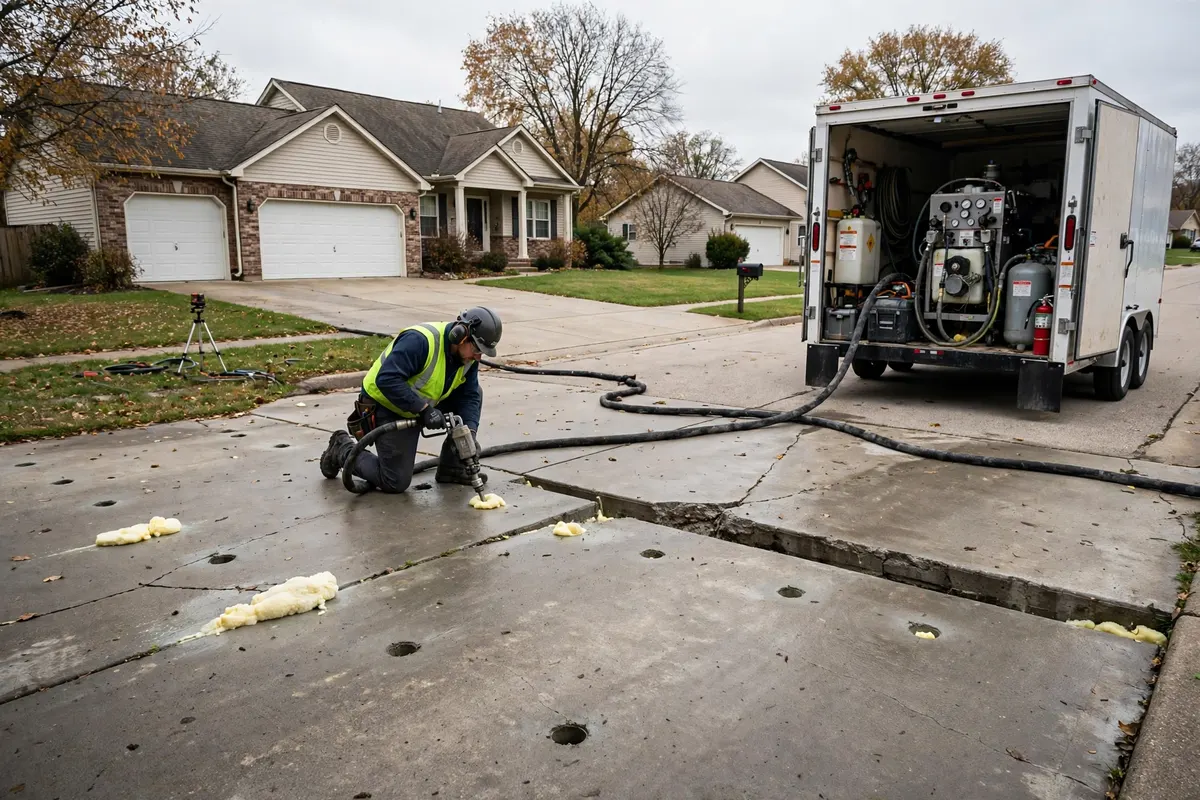
Wichita Foundation Repair repairs slabs with the tool the diagnosis calls for: polyurethane foam injection to lift and re-support settled sections precisely, piers where the slab edge or grade beam has dropped beyond foam's reach, and — always — a plumbing check, because lifting a slab over an active sewer or water leak is repairing the shadow instead of the cause.
Slab settlement is usually local — a corner, a room, the side the plumbing runs on. A level or a rolling marble confirms the direction; our elevation survey maps how far it has gone and whether it is still moving.
Rigid finishes telegraph slab movement first: grout lines cracking straight across a room, tile tenting, vinyl seams opening, hardwood cupping along a path. The floor finish is drawing you a map of the slab beneath it.
A crack you can see in exposed concrete — garage, patio, or under pulled carpet — that is offset or widening means one side has dropped or the other has heaved. Interior slab cracks get measured before they get filled.
Interior doors that drift, latch-side gaps that taper, and trim separating at the ceiling in one part of the house localize slab movement the way exterior cracks localize footing movement — the survey confirms which rooms are involved.
Warm spots on the floor, the sound of running water with everything off, a water bill climbing without explanation, or sewer odors: a leaking line under a slab both results from and causes movement, washing soil away from beneath the concrete. It gets found and fixed first, always.
Where the slab or grade beam is visible at the perimeter, a gap opening between soil and concrete, or the slab edge visibly lower than the driveway or patio it once met, shows the exterior half of the same settlement the floors report inside.
We map floor elevations across every room, test the plumbing (pressure and camera where indicated), and identify whether the slab settled, heaved, or lost support to a leak. The method follows the diagnosis — no foam is sold before the cause is known.
Settled interior sections with sound concrete are foam candidates. Dropped edges and grade beams get piers. Heaved areas get moisture correction, not lifting. You receive the plan with expected lift amounts stated honestly — including where level is not recoverable.
Small holes are drilled in a grid and polyurethane foam is injected beneath the slab, expanding to fill voids and lift in controlled increments while elevations are monitored continuously. The slab rises millimeters at a time, and we stop at support — over-lifting cracks slabs.
Where the perimeter has dropped, piers are installed at the grade beam and the edge is stabilized or lifted to meet the interior work, so the whole foundation system — not just the middle of the floor — is supported.
Injection holes are patched, final elevations recorded against the original survey, and you receive both maps plus the plumbing findings. The before-and-after numbers are the proof of the repair — and your record for insurance or resale.
Foam lifting is priced by area and void: published guides put slab lifting commonly between about $500 and $1,500 for a small settled section, with larger multi-room lifts running higher. Where piers are required, they price at the standard $1,250–$4,000 per pier, and a combined slab project lands inside the typical overall foundation range of $2,225–$8,133 for modest scopes, rising with pier counts toward underpinning territory.
The figure that should never appear later is the plumbing repair discovered mid-job — which is why leak detection comes first in our process and its findings are priced in the open. Our written quote separates foam, piers and plumbing into their own lines. If the survey says your slab is stable and the floor slope is an old, finished event, we will tell you that too — monitoring costs nothing.
Slab work attracts two kinds of shortcuts: foam sold as a cure-all (it cannot hold a dropped grade beam, and it cannot fix a leak), and piers sold where foam and a plumber were the whole answer. We do both kinds of work, which removes the temptation to sell either one — the survey and the leak test choose, and you see both results.
Precision is the other difference. Foam lifting is a millimeter trade: injected too fast or in the wrong sequence, it cracks the slab it was lifting. We lift in increments against live elevation readings, the same measurement discipline we bring to pier work, and the final survey — not our say-so — is what closes the job.
Ready when you are: call (316) 555-0147 for slab foundation repair anywhere in Wichita, Derby, Haysville, Bel Aire, Park City and the rest of the Wichita area.
Mudjacking pumps a heavy cement slurry that adds significant weight to already-failed soil and can wash out over time. Polyurethane foam is far lighter, cures in minutes, fills voids precisely, and is waterproof once set — the modern standard for interior slabs. We use foam for slab lifting; the honest exception is very large exterior voids, where we will discuss options.
Settled sections often recover most or all of their drop, but the goal is support and stability first, level second. Slabs that have cracked, or soil that has heaved rather than settled, limit what lifting can achieve. Your survey lets us state a realistic target for your home before any work is sold.
Signs include a rising water bill, warm floor spots, running-water sounds with fixtures off, sewer odor, and settlement concentrated along a plumbing run. We pressure-test the supply lines and camera the drains where indicated — before recommending structural work, because an unfixed leak undermines any repair.
Foam injection uses small (about 5/8 inch) holes, often through grout lines or from outside edges where possible; they are patched after. Existing rigid flooring may already be cracked by the movement itself. We walk the floor plan with you beforehand and note exactly where holes are needed — no surprises under the carpet.
Foam lifting for a typical settled area is often a single day, and the floor can be walked on within the hour after injection. Pier work at edges adds days as with any pier project. Plumbing repairs, when needed, are scheduled first and set the overall timeline.
On Wichita clay, foundation movement does not stop on its own — it pauses in wet months and advances in dry ones. A free inspection with floor-elevation readings tells you exactly where your home stands and what, if anything, it needs. No pressure, no obligation.