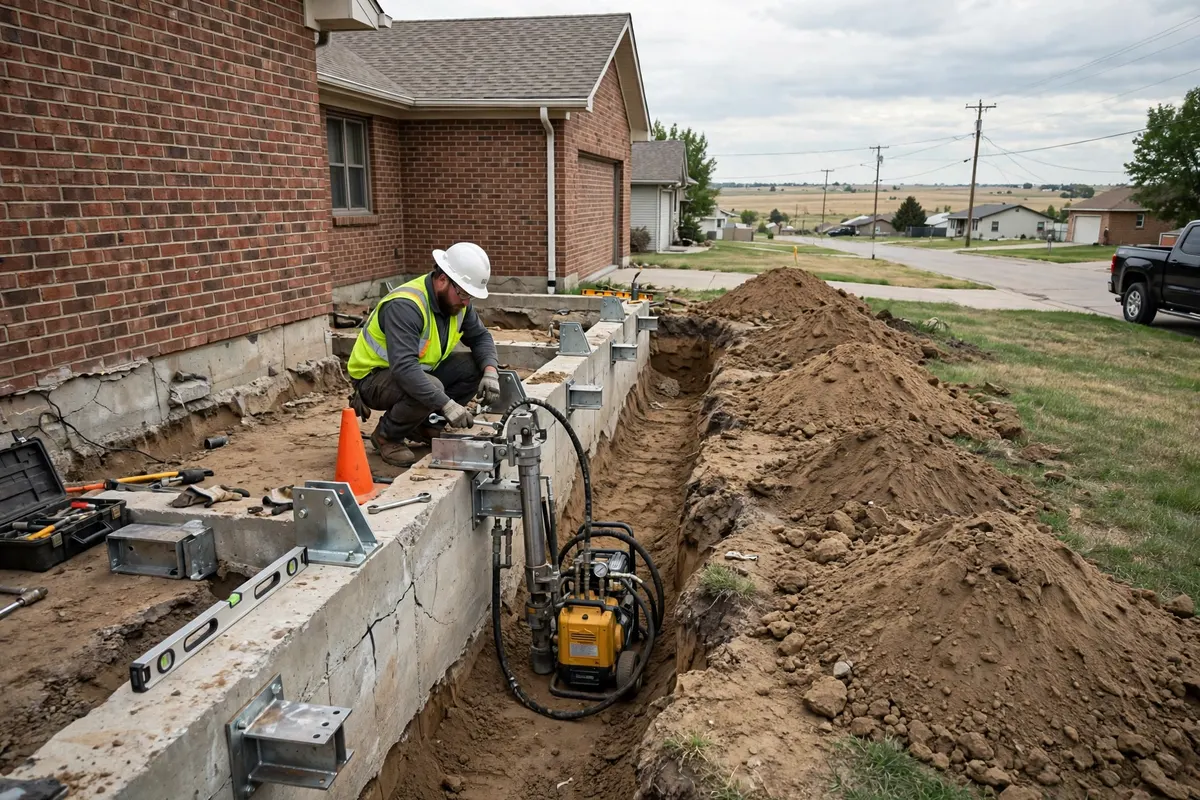
Foundation repair in Wichita is really soil repair by other means. The expansive smectite clay under much of Sedgwick County swells when it drinks in spring rain and shrinks — pulling away from footings — through Kansas summer droughts. Houses ride that cycle for decades until the movement shows: stair-step cracks in the brick, doors that will not latch, floors that slope to one corner. Repair means stopping the cycle at a depth the weather cannot reach.
Foundation repair crew installing steel piers along the exposed concrete foundation of a Wichita KS brick home.
Wichita Foundation Repair starts every job with measurement, not opinion: floor-elevation readings across the whole house, a crack and drainage survey outside, and a written plan that follows the numbers. Where a home has settled, steel piers carry it on stable strata below the active clay. Where it has heaved, we address the moisture that lifted it. Either way you approve one itemized price before any digging starts.
Signs Your Foundation Needs Repair — Not Another Patch
Stair-step cracks in brick or block
Cracks that zigzag through mortar joints in a stair pattern are the classic signature of a corner or wall section dropping. One hairline is weather; a stair-step you can fit a pencil into is movement, and it will keep stepping until the footing is supported.
Doors and windows that stick or will not latch
When a foundation drops on one side, every frame above it racks out of square. Doors that stick in summer and swing in winter, windows that need two hands, and latches that no longer meet are the house reporting its own elevation change.
Floors that slope, bounce or separate from walls
A marble that rolls to one corner, gaps opening between floor and baseboard, or tile and hardwood cracking along a line all point the same way. Our elevation survey turns the suspicion into a number — inches of drop, mapped room by room.
Cracks in the foundation wall itself
Vertical cracks wider than about 1/4 inch, cracks that are wider at one end, and especially horizontal cracks in a block wall (a wall being pushed inward by soil pressure) mean the structure is being moved or loaded beyond what it was built for.
Gaps around windows, doors and the chimney
Trim pulling away, caulk joints that split every year, brick separating from window frames, and a chimney leaning or cracking away from the house are exterior readings of the same story the interior tells.
The problem keeps coming back after cosmetic fixes
If you have patched the same drywall crack three times, re-shimmed the same door twice, or re-tuckpointed the same brick joint every few years, the cosmetics are fine — the cause underneath them has never been addressed.
How We Repair a Foundation — Our 5-Step Process
1
Measured inspection and an itemized written quote
We take floor elevations across the home, map every crack inside and out, check drainage and plumbing, and give you one written price with pier counts, excavation and restoration itemized. The price you approve is the price on the invoice.
2
Excavation to the footing
At each pier location we dig to the footing by hand or mini-excavator, protecting landscaping and utilities. The footing is cleaned and inspected — its condition decides bracket type and whether any concrete repair comes first.
3
Piers driven to load-bearing strata
Helical piers are screwed in or push piers hydraulically driven until they reach soil or rock that does not ride the wet-dry cycle. Each pier's depth and resistance are logged — your paperwork records exactly what is holding your house up.
4
Stabilize, then lift where the structure allows
Every pier is connected and the load transferred. Where a lift is safe and wanted, the home is raised slowly and evenly toward level while we watch walls, windows and plumbing — and we stop where the structure says stop, not where a sales target says.
5
Backfill, restore and document
Excavations are backfilled and compacted, concrete and landscaping restored, and you receive the pier log, elevation readings before and after, and photographs of the buried work. Doors usually tell the story within days.
What Does Foundation Repair Cost in Wichita, KS?
Published cost figures put a typical residential foundation repair between $2,225 and $8,133, and that range holds in Wichita for partial work — a few piers on one wall, or a crack and drainage package. Full underpinning runs higher: piers are priced at roughly $1,250–$4,000 each installed, a home needing 6–12 of them lands between $9,000 and $30,000, and large underpinning projects occupy the $10,000–$30,000 band. The honest variable is always how much of the perimeter has moved.
What moves the number is pier count, depth to stable strata, access (a pier inside a finished basement costs more than one in an open yard), and whether plumbing or concrete work rides along. Beware the two extremes of quote: the suspiciously cheap bid usually stops piers in the same active clay that caused the problem, and the padded bid sells piers on walls the elevation readings say never moved. You get our number itemized, in writing, against measurements you can see.
Why Wichita Homeowners Choose Wichita Foundation Repair
Foundation repair is where a contractor's honesty shows, because the evidence is buried the day the job ends. We photograph every excavation, log every pier depth, and hand you elevation readings before and after — the work you cannot see is documented anyway. If a pier is not needed, it is not on your quote, and the readings that prove it are in your hand.
We also tell you when you do NOT need us yet. A stable house with old, inactive cracks gets monitoring points and a drainage plan from us, not a pier proposal. Wichita is a small enough market that our reputation walks into the next neighborhood before we do — and foundation work is bought on reputation more than any trade we know.
How much does foundation repair cost in Wichita, KS?
Published figures put a typical job between $2,225 and $8,133. Piers run about $1,250–$4,000 each; a home needing 6–12 piers totals $9,000–$30,000. Your quote follows a free measured inspection and is itemized in writing before any work starts.
How long does foundation repair take?
Most residential pier jobs take 2–5 days: a day of excavation, a day or two of pier installation and lifting, and a day of backfill and restoration. Interior piers and large perimeters take longer. Weather and soil depth are the usual variables, and we give you a schedule with the quote.
Will the cracks in my walls close up after a lift?
Often partially, sometimes fully — brick and drywall cracks commonly narrow as the home returns toward level, and doors typically work again within days. We never promise a cosmetic result; the goal is a stable, supported structure. Cosmetic repairs are done after the lift, once the house has settled onto its piers.
Is foundation repair covered by homeowners insurance?
Settling and soil movement are excluded on standard Kansas policies as earth movement / wear and tear, so most repairs are out of pocket. Damage from a sudden plumbing leak is sometimes handled differently. We document everything either way, which helps if you do file.
Do repaired foundations come with a warranty?
Pier work should — and ours does: the pier system and the stabilized area are warranted in writing, and the warranty transfers to a new owner, which matters at resale. Ask any contractor you interview for the warranty terms in writing before you compare prices; the differences are real.
Need Foundation Repair in Wichita?
On Wichita clay, foundation movement does not stop on its own — it pauses in wet months and advances in dry ones. A free inspection with floor-elevation readings tells you exactly where your home stands and what, if anything, it needs. No pressure, no obligation.