Most foundation anxiety comes from not knowing. A crack might be nothing — or the first page of a $20,000 story — and from the doorway of a basement, the two look exactly alike. A real foundation inspection replaces that guesswork with measurement: floor elevations mapped across the whole house, every crack documented and classified, drainage and soil conditions read outside, and a written report that says what is moving, what is not, and what (if anything) should be done about it.
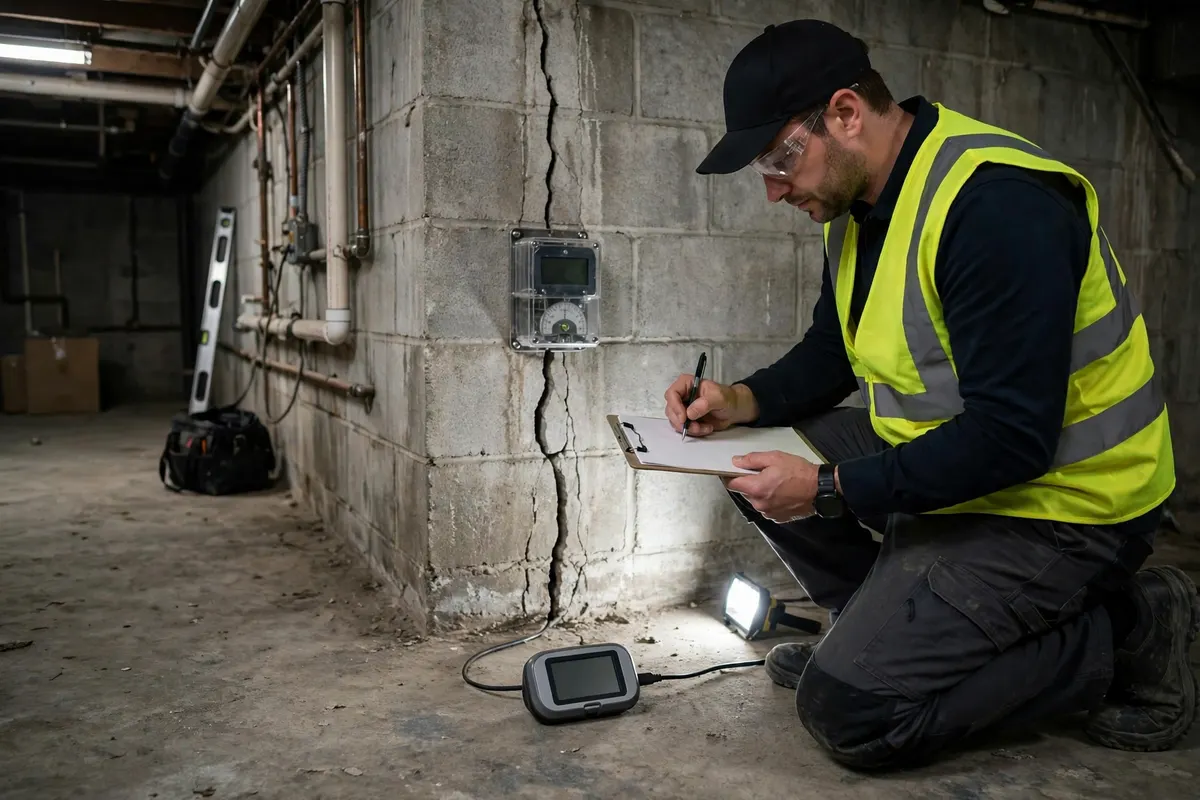
Foundation inspector measuring floor elevations with a digital level gauge during a Wichita KS home inspection.
Wichita Foundation Repair inspections are free for homeowners in the metro, and they are conducted the same way whether the answer turns out to be piers or 'paint over it.' Buyers use them before closing, sellers before listing, and owners before deciding whether the crack they found at spring cleaning deserves a contractor or a pencil mark and a calendar reminder.
When to Book a Foundation Inspection
You found cracks and want to know what they mean
Any crack wider than a hairline, growing, offset, or letting water in earns a measurement. The inspection classifies it — shrinkage, settlement, heave or pressure — and classification is what decides between sealant, monitoring and piers.
You are buying a home in the Wichita metro
A general home inspection flags 'foundation concerns' and stops there. Our inspection quantifies them: elevation maps and a written condition report you can negotiate with, budget from, or walk away on — before the clay becomes your problem.
You are selling and want no surprises
Kansas disclosure law means known foundation issues travel with the sale. A pre-listing inspection with documentation — stable readings, or repaired-and-warranted work — removes the buyer's worst-case imagination from the negotiation, where it does the most damage.
Doors, windows or floors changed this year
New sticking, new slopes, new gaps: change over time is the single most informative symptom a foundation gives. An inspection now establishes the baseline every future reading is compared against — the difference between evidence and memory.
After a plumbing leak, flood or drought summer
Events move foundations: a sewer leak washes support away, river-corridor flooding saturates one side, an exceptional drought shrinks clay deeper than usual. A post-event inspection catches movement while it is still a repair and not yet a renovation.
A lender, insurer or engineer asked for documentation
Refinances, insurance underwriting and real-estate contracts sometimes require a foundation condition letter. Our reports include the elevation data, photographs and findings those requests are actually asking for, in a format their reviewers accept.
How Our Foundation Inspection Works — 5 Steps
1
Walk-through and history
We start with what you have noticed and when — sticking doors, crack timelines, leaks, prior repairs — and walk the interior with you. Your observations are data; the timeline of symptoms often identifies the cause before an instrument comes out.
2
Whole-house floor elevation survey
Using a precision level gauge, we take elevation readings across every room and map them into a contour of the house: what is high, what is low, and by how much. This map is the inspection's core evidence and a copy goes in your report.
3
Crack and structure documentation
Every significant crack inside and out is photographed, measured and classified. We inspect the basement or crawl space structure — walls for bowing, beams and joists for condition — and check the chimney, additions and slab edges.
4
Exterior soil, drainage and plumbing review
Outside, we read the site: grading, gutter discharge, soil type at the footing line, tree proximity, and signs of plumbing trouble. Half of Wichita foundation movement is a water-management story, and this is where that half gets found.
5
Written report and straight recommendations
You receive the report with elevation map, photos and findings — and recommendations ranked: do now, monitor, or ignore safely. If work is needed, it is quoted itemized and separately. If none is, the report says so, and it costs you nothing.
What Does a Foundation Inspection Cost in Wichita, KS?
Our homeowner inspections in the Wichita metro are free, including the elevation survey and written report. Standalone third-party and engineering inspections in the market typically run a few hundred dollars, and where a licensed engineer's stamped letter is required — some lenders and structural disputes — we will tell you plainly and refer you rather than dress our report up as something it is not.
Why free? Because honest inspections are how a foundation company earns the work that actually exists. Some inspections end in pier quotes; plenty end in monitoring plans and gutter advice. Both outcomes produce the same thing for us — a homeowner who tells their street the truth about how we operate — and in a metro this size, that is worth more than an inspection fee.
Why Wichita Homeowners Choose Wichita Foundation Repair
An inspection is only worth the independence of its answer. Ours is built to survive your skepticism: the elevation map is raw data you keep, the crack classifications follow published structural conventions, and the recommendations separate 'now,' 'later' and 'never' — a contractor who only profits from 'now' does not write reports like that. Get a second opinion whenever you like; our numbers will hold up under it.
We also inspect like neighbors, because we are. Wichita's housing stock is our whole world — post-war Riverside bungalows, College Hill brick, Derby slabs, Andover two-stories — and the soil under each is a pattern we have measured hundreds of times. That local pattern library is what turns a reading of 'one inch low on the east' into a cause, a prognosis and a plan.
A whole-house floor elevation survey with a contour map, documentation and classification of all significant cracks, a structural look at the basement or crawl space, and an exterior review of soil, grading, drainage and plumbing signs — delivered as a written report with photographs and ranked recommendations.
How long does an inspection take?
Most homes take 60–90 minutes, including the walk-through conversation and the elevation survey. Large homes, crawl spaces with access challenges, and commercial properties take longer. The written report follows the same or next business day.
Is your inspection the same as a structural engineer's report?
No — and we will not pretend otherwise. Ours is a contractor's measured condition inspection, which answers most buying, selling and repair questions. When a stamped engineer's letter is required by a lender, a permit, or a dispute, we say so and can refer you to local engineers; our data often goes with you.
Should I get an inspection before buying a house in Wichita?
If the home shows any crack, slope, sticking or water symptom — or sits in the river corridors or deep-clay east side — yes. The report converts the seller's 'it has always been like that' into measurements, and gives you repair figures to negotiate with while you still can.
What if the inspection finds nothing wrong?
Then you get a report that says your foundation measured stable, a set of baseline elevation readings for future comparison, and usually a short list of drainage or monitoring suggestions. It costs nothing, and at resale that baseline documentation is genuinely useful. Good news is a deliverable too.
Need Foundation Inspection in Wichita?
On Wichita clay, foundation movement does not stop on its own — it pauses in wet months and advances in dry ones. A free inspection with floor-elevation readings tells you exactly where your home stands and what, if anything, it needs. No pressure, no obligation.