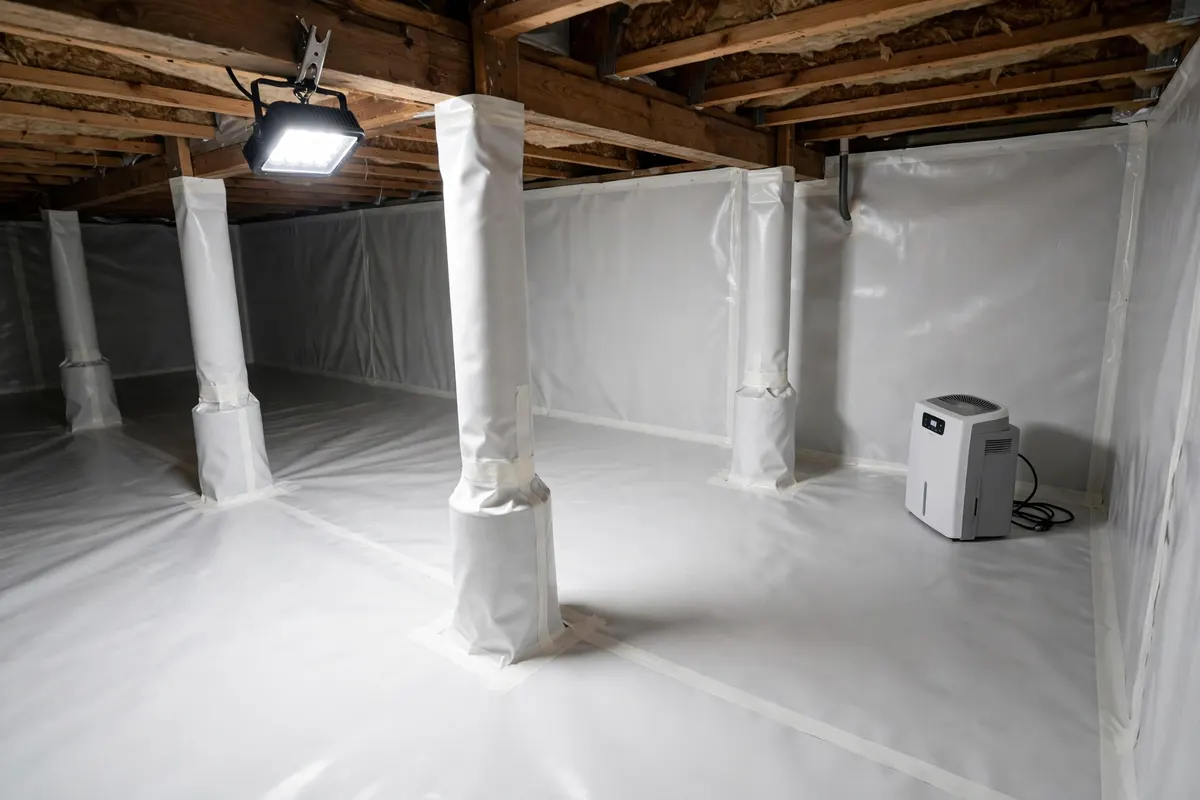
A vented Kansas crawl space spends the summer drinking humid air and the winter soaking up clay moisture — and everything under the house pays for it: joists and subfloor rot slowly, insulation sags and falls, floors bounce, and the air your family breathes rises straight through the house from that damp space below. Roughly half the air in a home comes up from under it. A crawl space is not out of sight; it is upstream.
Newly encapsulated crawl space with a white sealed vapor barrier and dehumidifier under a Wichita KS home.
Wichita Foundation Repair fixes crawl spaces in the right order: structure first (supports under sagging floors), water second (drainage and a sump where the clay delivers water), then full encapsulation — a heavy sealed vapor barrier on floor and walls, vents closed, and a dehumidifier holding the space dry year-round. The result is a clean, dry, inspectable space that stops costing the house above it money.
Signs Your Crawl Space Needs Repair
Musty smell inside the house, worst in summer
Stack effect pulls crawl space air up through the home. If the house smells earthy no matter how much you clean — especially on humid days — the source is usually below the floor, growing in damp wood and soil air.
Bouncy, sagging or uneven floors
Floors that flex, dip toward the middle of rooms, or have pulled away from walls point to joists and beams weakened by moisture, or piers and posts that have settled into soft clay. Supplemental steel supports, properly footed, are the standard correction.
Fallen or hanging insulation
Fiberglass batts absorb crawl space moisture until their weight pulls them down — after which they insulate nothing and hold damp against the joists. Fallen insulation is a moisture report, not just an insulation job.
Standing water or mud after rain
Water standing under the house after Kansas storms means the clay has delivered it and nothing is removing it. Standing water drives every other crawl space problem — rot, mold, pests, odor — and needs drainage and a sump, not a fan.
Mold, rot or termite evidence on joists
White or black growth on wood, joists soft to a screwdriver, and mud tubes on piers are the late stages of a wet crawl space. The wood repairs come first; encapsulation is what keeps the repair from being needed again.
Cold floors and high heating bills
A vented crawl space in a Kansas winter is a cold-air reservoir under your floors, and a humid one in summer loads your AC with moisture it must remove. Encapsulated crawl spaces routinely change both bills — the space becomes part of the house's envelope instead of a hole in it.
How We Repair & Encapsulate a Crawl Space — Our 5-Step Process
1
Inspect structure, water and wood
We crawl the whole space with lights and a moisture meter: joists, beams, piers, plumbing, ductwork, and the soil itself. You get photos and a plan in the right order — structure, water, then sealing — with each stage priced separately so you can phase the work if needed.
2
Repair structure and add supports
Rotted wood is replaced or sistered, and supplemental steel jacks on proper footings are installed under sagging beams — slowly lifting floors only where the structure allows, and documenting elevations before and after.
3
Solve the water
Where storms deliver water, an interior perimeter drain and sump basin go in first. Encapsulating over a water problem just hides it under plastic; drainage is what makes the dry space permanent rather than seasonal.
4
Encapsulate — barrier, sealed vents, conditioned air
A heavy-duty liner is run across the floor and up the walls and piers, seams overlapped and sealed, vents closed, and rim joists insulated. A crawl-space dehumidifier is installed and set — the space becomes clean, white, dry and easy to inspect at a glance.
5
Verify, document and hand over
We photograph the finished space, record humidity targets, and show you the access and the dehumidifier service rhythm. Future plumbers and inspectors will thank you — and at resale, a clean encapsulated crawl space reads as care, not concealment.
What Do Crawl Space Repair & Encapsulation Cost in Wichita, KS?
Published cost guides put full encapsulation most often between about $1,500 and $15,000, with typical whole-space projects clustering near $5,000–$7,000 depending on size, liner grade and whether drainage and a dehumidifier are included. Structural work is separate: supplemental supports are priced per jack and footing, and wood repair by the joist and beam involved.
Because the stages are separable, we price them separately: many Wichita homes need drainage and encapsulation but no structure; others need four jacks and nothing else. The inspection sorts it with photos and moisture readings, and the written quote shows each stage's price — so you can do it all at once or phase it across seasons without paying for the same mobilization twice.
Why Wichita Homeowners Choose Wichita Foundation Repair
The crawl space industry sells plastic; we sell the order of operations. Liner over standing water, or jacks on mud footings, or a dehumidifier fighting an open vent — each is money spent against itself. Our inspections show you the space the way we see it, photographs included, and the plan fixes causes in sequence. That is why our encapsulated spaces stay dry instead of staying sold.
We also build for the next person who has to go down there. Access stays clear, the liner is heavy enough to crawl on, plumbing and ducts remain reachable, and the sump and dehumidifier are placed to be serviced. A crawl space you can inspect in thirty seconds is a crawl space whose problems get caught while they are still small.
For a home with moisture, odor, floor or energy symptoms, yes — it addresses the cause of all four. Kansas humidity and clay moisture make vented crawl spaces a losing design here; sealing the space and controlling humidity is the correction the building science supports. For a dry, problem-free space, we will tell you a simple vapor barrier and monitoring may be enough.
How long does encapsulation take?
A typical home takes 2–4 days: structure and drainage first if needed, then liner and dehumidifier. Large spaces and heavy wood repair take longer. The house stays fully livable throughout — all the work happens below it.
Will encapsulation fix my sagging floors?
Encapsulation alone does not lift floors — supports do. Supplemental steel jacks on footings correct the sag; encapsulation then protects the repaired wood from the moisture that weakened it. Our inspection separates the two and prices each, so you know exactly what you are buying.
What humidity should an encapsulated crawl space hold?
Below 55% relative humidity year-round is the working target — under the threshold mold needs. The dehumidifier is sized to the space and set to hold that range, and we verify readings at handover. A simple remote hygrometer lets you confirm it from upstairs anytime.
Does encapsulation help with pests and radon?
A sealed liner removes the moisture and access that draw termites and other pests, and makes termite evidence easy to spot at inspection. For radon — which Kansas homes should test for — a sealed crawl space is the platform a mitigation system builds on, though encapsulation alone is not a radon system.
Need Crawl Space Repair & Encapsulation in Wichita?
On Wichita clay, foundation movement does not stop on its own — it pauses in wet months and advances in dry ones. A free inspection with floor-elevation readings tells you exactly where your home stands and what, if anything, it needs. No pressure, no obligation.